
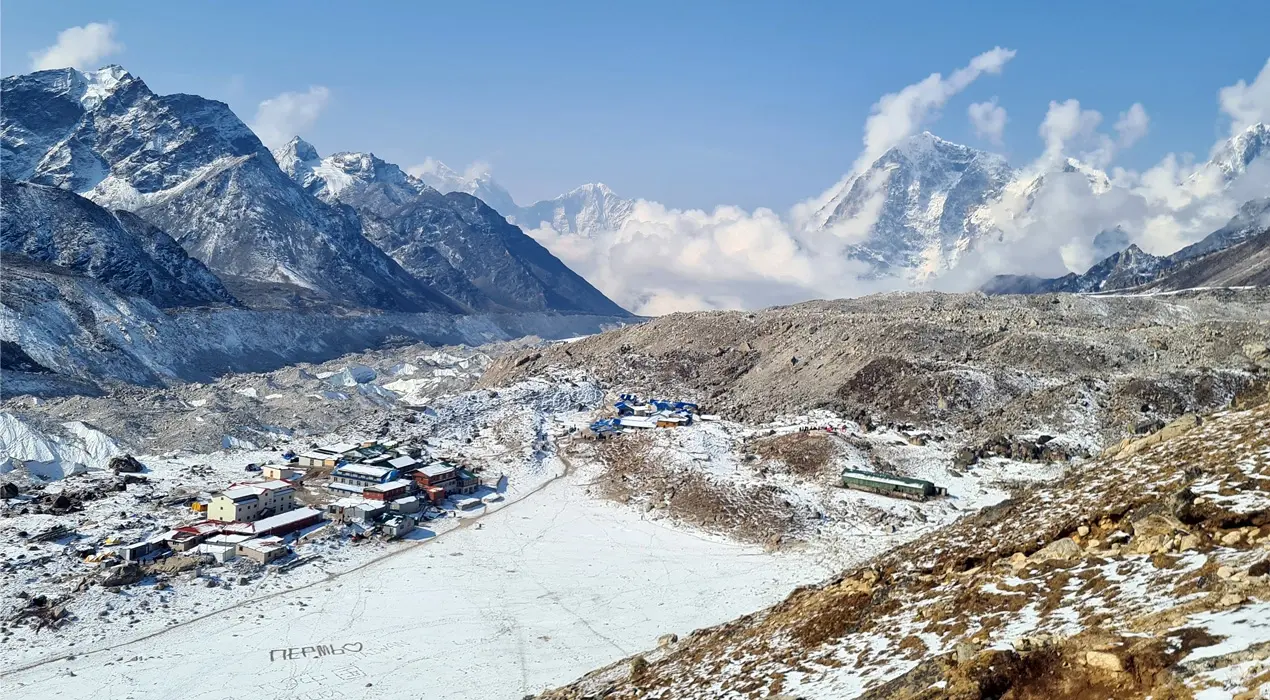

Most people picture the Everest Base Camp trek in October or April, with busy trails and full lodges. Winter is a different trip. From December to February the Khumbu goes quiet, the sky is clear on most days and the mountains look sharper than at any other time of year. It is also seriously cold: at Base Camp, the average January night falls to about −13°C.
So is it worth it? For a fit trekker who packs properly and doesn’t mind cold evenings, yes. This guide uses six years of readings from the weather stations on the route to show how cold it really gets, then covers lodges, Lukla flights, the gear you need and how we change the Everest Base Camp trek itinerary for winter.
Key takeaways
- Winter on the Everest trail runs from December to February. It is the driest time of year: the Base Camp weather station records about 27 mm of rain and snow across all three months, against 484 mm in the monsoon.
- At Base Camp, average night lows are −10°C in December and close to −13°C in January and February. The coldest reading since 2019 is −22.3°C.
- Lodges stay open all the way to Gorak Shep, but fewer of them, and bedrooms are unheated.
- Pack a sleeping bag rated to −20°C, a heavy down jacket, mitts and microspikes. We lend the sleeping bag and down jacket free if you need them.
- Leave one or two spare days for Lukla flights, and buy insurance that covers trekking to 6,000 m and helicopter rescue.
How cold is Everest Base Camp in winter?
Colder than the brochures usually admit. National Geographic and Rolex installed automatic weather stations on Everest in 2019, and their hourly data is public. One station sits at Base Camp (5,315 m). Another is in Phortse (3,810 m), a village across the valley from Tengboche, so it shows what to expect at the trek’s middle altitudes. We worked out the monthly averages below from the stations’ hourly records between 2019 and 2025, in Nepal time.
Month | Base Camp, 5,315 m: average low / high | Phortse, 3,810 m: average low / high |
|---|---|---|
October (for comparison) | −5.3°C / 2.0°C | 2.8°C / 9.6°C |
November | −8.0°C / −0.5°C | −1.4°C / 6.6°C |
December | −10.1°C / −3.1°C | −4.6°C / 3.0°C |
January | −12.6°C / −5.3°C | −6.0°C / 1.5°C |
February | −12.8°C / −5.0°C | −5.9°C / 1.8°C |
Coldest reading, 2019–2025 | −22.3°C (5 February 2022) | −13.7°C (5 February 2022) |
Three things these numbers don’t show. First, they are shade temperatures. On a still, sunny morning at Gorak Shep you can walk in a fleece, because the sun at that altitude is strong. Second, the wind changes everything: a light breeze at −12°C feels well below −20°C on exposed skin. Third, the temperature drops quickly once the sun goes behind the ridge, usually around 3 or 4 pm in the high valleys. After that, you want to be inside.
In short, a winter trek is about 5 to 7°C colder than the same trek in October. That is the trade for the quiet trail and the clear views.
What is the weather like on the trek in winter?
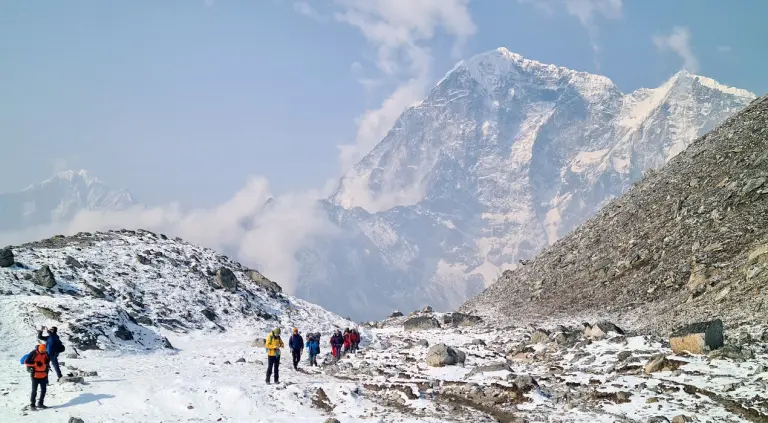
Mostly dry and clear. The monsoon brings about 77% of Base Camp’s yearly precipitation; winter brings very little. According to the peer-reviewed analysis of the same stations, Base Camp averages 27 mm of precipitation across December, January and February, and Phortse averages 56 mm. Most winter days start cloudless. Cloud often builds in the afternoon, then clears again overnight.
Snow does fall, usually in a few short storms rather than steady weather, and more often towards late January and February. A heavy fall can close the trail above Dingboche for a day or two until it is packed down. That is one reason we keep a spare day in every winter itinerary.
The days are also shorter. At Lukla the sun is up for about 10 hours 23 minutes on 21 December, against 11 hours 33 minutes in mid-October, and in deep valleys like Phakding and Pheriche it reaches the floor later still. In winter we start walking at about 8 am, once the sun is on the trail, and aim to arrive by 3 pm.
Are teahouses open on the Everest Base Camp trek in winter?
Yes, all the way to Gorak Shep, but with less choice the higher you go. Lodges in Lukla, Namche Bazaar and Tengboche run as normal. In Lobuche and Gorak Shep, some owners close for the coldest weeks of January and move down to Namche or Kathmandu. There is always somewhere to stay, and we call ahead to book the next night’s rooms.
What a winter lodge is like:
- Bedrooms are unheated. A water bottle left on the bedside table will often be frozen by morning, so keep it in your sleeping bag.
- The dining room is the warm room. A stove, often burning dried yak dung, is lit in the evening, and everyone sits around it until bedtime.
- Hot showers and charging cost extra above Namche, and solar-heated showers may not work on cold days. Batteries drain fast in the cold, so keep your phone and power bank in an inside pocket and in your sleeping bag at night.
- Food is the same menu as in season: dal bhat, noodle soups, potatoes, eggs and tea. Eat well; your body burns more energy keeping warm.
Do Lukla flights run in winter?
Yes. In the busy spring and autumn seasons, Lukla flights are moved from Kathmandu to Manthali airport in Ramechhap, a four to five hour drive away, to ease traffic at Kathmandu airport. Outside those seasons, flights usually leave from Kathmandu itself, which saves a very early drive. We confirm the departure airport when we book your tickets.
Winter mornings are often clear, which helps, but cloud, wind or fog can still stop flights at Lukla for a day or more. Leave at least one spare day between the end of the trek and your international flight home. Two is safer in February.
Our 14-day itinerary in winter
The route is the same as in other seasons, with the same two acclimatization days. Climbing slowly matters just as much in winter, and the cold makes altitude sickness harder to spot, because a headache or tiredness is easy to blame on the weather. Our guide to preventing altitude sickness on the Everest Base Camp trek explains the warning signs.
Day | Overnight | Altitude | Winter note |
|---|---|---|---|
1 | Kathmandu | 1,355 m | Gear check; rent or borrow anything missing |
2 | Phakding | 2,610 m | Fly to Lukla (2,860 m); short first day |
3 | Namche Bazaar | 3,440 m | Shaded climb; can be icy in the morning |
4 | Namche Bazaar | 3,440 m | Acclimatization hike to the Everest View Hotel (3,880 m) |
5 | Tengboche | 3,860 m | Nights around −5°C |
6 | Dingboche | 4,410 m | Wind picks up in the afternoon; arrive early |
7 | Dingboche | 4,410 m | Acclimatization hike to Nagarshan viewpoint (5,083 m) |
8 | Lobuche | 4,940 m | Fewer lodges open in January |
9 | Gorak Shep | 5,164 m | Visit Base Camp (5,364 m) at midday, the warmest time |
10 | Pheriche | Below 4,400 m | Kala Patthar (5,545 m), then a long descent |
11 | Namche Bazaar | 3,440 m | Back in comfortable lodges |
12 | Lukla | 2,860 m | Last trekking day |
13 | Kathmandu | 1,355 m | Fly back; the spare day starts here if flights are delayed |
14 | Departure | – | Keep a buffer before your flight home |
Two changes we often make in winter. Most groups climb Kala Patthar before dawn for the sunrise, but in January that means starting at about −15°C in the dark. Many of our winter groups go up after the sun has risen instead: you lose the sunrise colours, but you gain several degrees and still get the full view of Everest. And if the group is moving well, we sometimes swap the order of Base Camp and Kala Patthar to match the weather on the day.
If you want more room for weather and rest, the 18-day Everest Base Camp trek with more acclimatization adds extra nights on the way up.
What to pack for Everest Base Camp in winter
Start with our full Everest Base Camp packing list, then make these winter changes:
- Sleeping bag rated to −20°C (comfort). A fleece liner adds a few degrees.
- Heavy down jacket with a hood, warm enough to sit in at −15°C. We lend a sleeping bag and a down jacket at no cost if you don’t have your own.
- Two pairs of gloves: thin liners for walking and insulated mitts for evenings and the Kala Patthar climb.
- Thermal base layers, top and bottom, plus a warm fleece and insulated trousers for the evenings.
- Waterproof boots with room for thick wool socks. Tight boots mean cold feet.
- Microspikes for icy sections, especially between Lobuche and Gorak Shep and on shaded descents.
- Insulated water bottles (or bottles with covers). Fill them with hot water at night and put them in your sleeping bag.
- Category 4 sunglasses, sunscreen and lip balm. Snow glare at altitude can burn your eyes, and the dry winter air cracks lips within days.
Your porter carries up to 20 kg for two trekkers, so pack warm, not heavy: one good down jacket is better than three fleeces.
Is winter safe for the Everest Base Camp trek?
Yes, with a good guide, a sensible pace and the right gear. Avalanche risk on the standard route is low, and the main dangers are the same as in other seasons: altitude sickness, slips on ice and getting cold. Two things are different in winter.
First, there is less medical help on the trail. The Himalayan Rescue Association’s aid post in Pheriche is staffed by volunteer doctors during the main trekking seasons, so don’t count on finding a doctor there in winter. Your guide’s first aid and your own early reporting of symptoms matter more.
Second, rescue depends on the weather. Helicopters fly most clear winter mornings, but not in cloud or high wind. Make sure your insurance covers trekking up to at least 6,000 m and helicopter evacuation; our guide to trekking insurance and altitude sickness in Nepal explains what to check.
Permits and cost in winter
Winter doesn’t change the paperwork. You need the Sagarmatha National Park entry permit, which costs NPR 3,000 per person for most foreign nationals according to the Nepal Tourism Board, and the Khumbu Pasang Lhamu Rural Municipality entry fee, which has been NPR 3,000 per person for most foreign nationals (NPR 2,000 for SAARC and Chinese nationals) since July 2024, as reported by Himal Press. It is collected at Lukla, or at Monjo if you walk in. Both are included in our trip price. Our guide to trekking permits in Nepal covers the details.
Our 14-day Everest Base Camp trek starts from US$1,115 per person, and the price is the same in winter. For a full breakdown of what a trek costs, including tips, drinks and charging, see Everest Base Camp trek cost in 2026.
Is the Everest Base Camp trek worth it in winter?
Choose winter if:
- you want quiet trails and your pick of the views at Kala Patthar (the national park office counted 8,902 visitors in a single autumn month, mid-September to mid-October 2024, and winter brings far fewer);
- you have trekked or camped in cold weather before, or are happy to learn;
- your holidays fall between December and February anyway.
Choose spring or autumn if:
- you have never slept somewhere below freezing and don’t want to start at 5,000 m;
- you want the social side of busy lodges;
- your dates are fixed with no spare days for flights.
If you’d like to see Everest in winter without the cold of the high camps, the 8-day Everest Panoramic View Trek goes no higher than Tengboche (3,860 m) and still gives a clear view of Everest, Lhotse and Ama Dablam. Our month-by-month guide to trekking in Nepal compares the seasons.
Frequently asked questions
Is Everest Base Camp open in winter?
Yes. The trail, the national park and the lodges stay open all year. In January some higher lodges close for a few weeks, but there is always somewhere to stay at each stop.
Which winter month is best for the Everest Base Camp trek?
December. It is the mildest of the three winter months (an average low of −10.1°C at Base Camp, against −12.6°C in January) and usually the driest. January has the coldest days, and February has the coldest nights and a higher chance of snow.
Is there snow at Everest Base Camp in December?
Usually there is a thin cover of old snow and ice, but heavy snowfall is uncommon, because winter is the driest season. One storm can still leave enough snow to slow the trail for a day or two, which is why we plan a spare day.
Can you see Mount Everest in winter?
Yes, and usually more clearly than in any other season. The dry air gives the sharpest views from Kala Patthar and the Everest View Hotel. On windy days you may see a long plume of snow blowing from the summit.
Can you cross the Cho La pass in winter?
Sometimes. The Cho La (5,420 m) between Everest Base Camp and Gokyo is often icy and can be closed by snow in January and February. We decide on the day with local lodge owners, and on winter trips we plan a backup route through the valley instead.
Sources and data notes. Monthly temperatures are our calculations from the hourly data of the National Geographic and Rolex Perpetual Planet weather stations at Base Camp and Phortse, published on Zenodo. Seasonal precipitation figures are from Khadka and colleagues, Weather station data from the Mount Everest region, Nepal, Earth System Science Data (2026). Daylight hours are calculated for Lukla. Permit fees are from the Nepal Tourism Board and Himal Press, and the autumn visitor count is from the Sagarmatha National Park office as reported by Khabarhub (October 2024); all checked in November 2026.